Toggle Switches
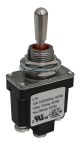
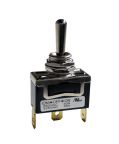
Toggle switches are electrical switches operated by a lever or handle that flips up or down to open or close a circuit. They offer a simple, tactile way to manually turn devices or circuits on or off and are found across industrial, automotive, and consumer applications.
How Toggle Switches Work
A toggle switch uses a mechanical lever to move internal metal contacts between fixed positions, controlling whether current can flow through the circuit.
- Lever Action: Flipping the handle moves an internal mechanism linked to conductive contacts.
- On Position: The contacts meet, completing the circuit and allowing current to flow.
- Off Position: The contacts separate, breaking the circuit and stopping the flow of electricity.
- Multiple Throws: In multi-position configurations such as an on-off-on switch toggle, the lever can route current between different circuits depending on its position.
The result is a predictable, visually clear switching action that remains consistent across a high number of mechanical operations.
The Benefits of Toggle Switches
Toggle switches remain a popular choice because they combine straightforward operation with robust performance across many environments.
- Simplicity and Reliability: Their basic mechanical design reduces complexity and supports consistent operation when correctly specified and installed.
- Manual Control: Operators can directly turn devices on or off or switch between functions without software or electronic control systems.
- Versatility: Available in numerous configurations, sizes, and ratings, from low-voltage signal switching to higher-power control circuits.
- Visual Feedback: The lever position provides instant confirmation of the switch state, reducing operator error.
- Cost-Effectiveness: Generally affordable compared with electronic or specialised switches, making them suitable for high-volume use.
- Durability: Sturdy housings resist dust, moisture, and vibration, supporting long service life in demanding settings.
Types of Toggle Switches
Toggle switches come in several forms to suit different electrical loads, mounting methods, and operating environments.
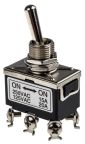
- Double-Pole Double-Throw Toggle Switch: A double-pole double-throw (DPDT) toggle switch controls two separate circuits simultaneously, with each pole able to connect to one of two throws. It is commonly used to reverse motor direction or to select between two power sources.
- Double-Pole Single-Throw (DPST) Toggle Switch: A DPST toggle switch functions as two single-pole double-throw (SPST) switches sharing a single actuator, switching two independent circuits on or off simultaneously. It is commonly used in mains-powered equipment where both the live and neutral conductors must be isolated together for safety compliance.
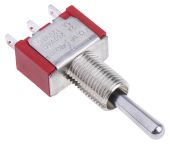
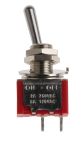
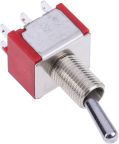
- Small/Miniature Toggle Switch: A small toggle switch or miniature toggle switch offers the same reliable action in a reduced footprint, ideal for compact instrument panels and handheld equipment.
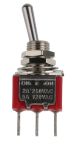
- 3-Pin Toggle Switch: A 3-pin toggle switch is typically a SPDT toggle switch, providing a common terminal and two switched output terminals for two-way signal or power routing. In contrast, a basic SPST switch has 2 pins and a DPDT has 6 pins, so matching pin count against the required circuit configuration is an important step during selection.
- Heavy-Duty Power Toggle Switch: Rated for higher currents and voltages, these toggles are built for industrial control, machinery, and power distribution applications.
- Waterproof IP67 Toggle Switch: Sealed toggle switches rated to IP67 resist water and dust ingress, making them suitable for marine, outdoor, and washdown environments.
- Illuminated LED Toggle Switch: Integrated LEDs provide clear visual confirmation that a circuit is live, useful in dimly lit control rooms and operator consoles.
- Right-Angle PCB Toggle Switch: A right-angle PCB toggle switch mounts horizontally onto a circuit board, allowing front-panel actuation without additional wiring or brackets.
- High-Temperature Toggle Switch: Constructed with heat-resistant materials, these switches operate reliably in engine bays, industrial ovens, and other elevated-temperature environments.
- On-Off-On Toggle Switch: An on-off-on toggle switch is a three-position variant that provides two active circuits separated by a central off position. Flipping the lever up activates one circuit, flipping it down activates another, and the middle setting isolates both.
- Locking Toggle Switch: Locking toggle switches require a lever to be pulled outward before they can be flipped, preventing accidental activation in safety-critical or high-vibration applications such as aerospace panels, military equipment, and industrial emergency systems. Some designs incorporate a protective cover or guard that must be lifted before the switch can be operated.
How to Select the Right Toggle Switch
Choosing the right toggle switch requires matching its electrical, mechanical, and environmental specifications to the intended application.
- Current and Voltage Requirements: Confirm the switch rating meets or exceeds the circuit load, including inrush currents for inductive loads.
- Contact Configuration: Select the correct pole and throw arrangement, from a single-pole single-throw toggle switch for simple on-off control to multi-pole variants for more complex circuits.
- Switching Action (Latching vs. Momentary): Determine whether a maintained or momentary action is required. Latching (maintained) toggle switches remain in their selected position until manually changed, making them suitable for continuous operation, such as power control. Momentary switches, often indicated in datasheets as “on-off-on”, return automatically to their default position when released and are used for temporary functions such as jogging, resetting, or test operations.
- AC or DC Contact Rating: Toggle switches are often rated separately for AC and DC loads, as DC switching is more demanding on contacts because it lacks a natural current zero-crossing to extinguish arcing. Always verify that the switch's DC voltage and current rating matches the application, particularly in automotive, battery, and renewable energy systems, where DC loads are the norm.
- Mounting Hole Size: Standard bushing diameters range from miniature fittings through to larger heavy-duty formats, so the panel cut-out must match.
- Panel Thickness Compatibility: Check that the threaded bushing length accommodates your panel thickness to ensure secure and stable mounting.
- Environmental Protection (IP Rating): Select an appropriate IP rating based on exposure to dust, water, or chemicals, with sealed or boot-covered options for harsher environments.
- Termination Style: Choose between solder lugs, screw terminals, quick-connect (QC) tabs, or PCB pins based on how the switch will be wired.
- Actuator Length and Style: Handle length, shape, and finish affect both ergonomics and aesthetics, with bat, paddle, and locking levers available.
- Illumination Needs: Decide whether an illuminated lever or an integrated LED indicator is required for operator visibility.
Industrial Applications of Toggle Switches
Toggle switches are used across a wide range of industries wherever clear, manual switching is needed.
- Industrial Control Panels: Used for manual overrides, machine start-stop functions, and mode selection on production equipment.
- Automotive Dashboards: Control auxiliary lighting, winches, and custom electrical accessories in vehicles and fleet equipment.
- Audio Equipment: Route signals, engage effects, and select inputs on mixers, amplifiers, and studio hardware.
- Power Supplies: Provide main and secondary on-off control on bench power supplies and distribution units.
- HVAC Systems: Switch fans, pumps, and heaters in heating and cooling control panels.
- Marine Electronics: Sealed toggle switches control navigation lights, bilge pumps, and instrumentation on boats and offshore platforms.
- Aerospace and Aviation: Used in cockpit panels and ground support equipment where tactile, positive-action switching is critical.
- Telecommunications: Manage power and signal routing in base stations, test equipment, and network cabinets.
- Robotics: Provide manual enable, reset, and emergency control functions on robotic platforms and automated cells.
The Leading Supplier and Distributor of Toggle Switches in Malaysia
As a leading supplier of toggle switches in Malaysia, RS stocks an extensive catalogue from well-regarded manufacturers including RS PRO, APEM, and NKK Switches. Toggle switch prices depend on factors such as current rating, contact configuration, and environmental sealing, with options ranging from compact miniature units for signal work to heavy-duty metal toggle switch designs engineered for industrial duty.
Our online catalogue also covers other switching and control components such as rocker switches, emergency stop switches, and push button switches to complete your build. RS Malaysia offers next day delivery on qualifying orders, helping you keep control panels, machinery, and maintenance projects on schedule. Visit our delivery page for full details on shipping options and timelines.
Popular Searches
Related links
- APEM Toggle Switch Latching
- Marquardt Toggle Switch Latching Screw Terminal
- Marquardt Toggle Switch Latching Solder Terminal
- APEM Toggle Switch Latching Solder Terminal
- NKK Switches Toggle Switch Latching Solder Terminal 250 V ac
- NKK Switches Toggle Switch Latching Screw Terminal 250 V ac
- TE Connectivity Toggle Switch Latching Solder Terminal 125 V ac
- Toggle Switches & Slide Switches