- Published 17 Nov 2025
- Last Modified 17 Nov 2025
- 11 min
A Complete Guide to Reed Switches
A guide to reed switches. Learn what is a reed switch and reed sensor, how a reed switch works, advantages, disadvantages, and where they are used.

An in-depth guide to reed switches. Learn what is a reed switch, how it works, and what they are used for in industrial applications across Malaysia.

What Is a Reed Switch?
A reed switch is an electrical switch operated by a magnetic field. Its name is derived from the thin, flexible ferromagnetic "reeds" enclosed in a hermetically sealed glass capsule. This sealed design protects the switch contacts from environmental factors like dust and moisture, ensuring consistent and long-lasting performance. Reed switches are fundamental components in many automation, security, and industrial applications, valued for their reliability and simplicity.
The contact reeds are typically made from a nickel-iron alloy, chosen for their magnetic properties and spring-like flexibility. The glass enclosure isolates the contacts from external contamination and corrosion, which enhances durability in harsh industrial environments.
How Does a Reed Switch Work?
How do magnetic reed switches work? The function is based on the principle of magnetic actuation. When a magnetic field from a nearby permanent magnet or electromagnetic coil is brought close to the switch, it magnetises the reeds.
Here’s a breakdown of how a reed switch works:
- The magnetic field magnetises the ferromagnetic reeds, temporarily turning them into magnets with opposite polarities.
- This magnetic attraction causes the reeds to bend toward each other until they touch, completing the electrical circuit and changing the switch's state.
- The switch remains in this closed or "on" state as long as the magnetic field is present.
- Once the magnetic field is removed, the natural spring force of the reeds causes them to separate, returning the switch to its open or "off" state.
- This contactless switching mechanism allows for non-mechanical operation, minimising wear and improving reliability.
Types of Reed Switches
To answer what are reed switches used for or where are reed switches used, the application and desired circuit behaviour dictate the specific type of reed switch required. While they all operate on the same fundamental magnetic principle, different configurations are designed for different functions, from simple on/off switching to more complex circuit control.
The three primary types of reed switches are:
- Normally Open (NO): This is the most common type. In its default state, the contacts are open, meaning no current can flow. When a magnetic field is applied, the contacts close, completing the circuit. This is ideal for applications where the switch needs to activate a device or send a signal when a magnet is present, such as in door sensors and alarm systems.
- Normally Closed (NC): The contacts are closed in their inactive state, allowing current to flow. When a magnetic field is applied, the contacts separate, and the circuit is broken. These switches are often used for safety applications where a break in the circuit is required to signal an event, such as an alarm being triggered when a door is opened and the magnet is removed.
- Changeover (SPDT - Single Pole Double Throw): This type has a common contact that can be switched between two other contacts, creating both a normally open and a normally closed circuit. When a magnetic field is applied, the common contact switches from the NC position to the NO position. This configuration is highly versatile and allows for more complex control, as it can be used to simultaneously activate one circuit and deactivate another with a single magnetic field.
Reed Sensors
What is a reed sensor? A reed sensor is a complete, packaged device that integrates a reed switch into a functional unit, often with additional components like resistors, wiring, or a protective housing for easy installation. While the terms are sometimes used interchangeably, a reed sensor is a more sophisticated, ready-to-use component. The key difference lies in their form and function.
- Reed Switch: An individual component, just the glass-encapsulated switch itself. It's a fundamental building block.
- Reed Sensor: A complete, pre-assembled product that incorporates the reed switch and supporting components to provide functional sensing capability for direct integration into systems.
What Does a Reed Switch Do
So, what does a reed switch do? At its core, it acts as a reliable, magnetically-activated electrical switch. Its primary function is to open or close an electrical circuit in response to a nearby magnetic field, without any physical contact between the activating magnet and the switch contacts.
The key functions of a reed switch include:
- Contactless Switching: The switch operates without any physical contact between the moving parts and the external activating magnet, eliminating wear and tear associated with mechanical buttons or levers.
- Electrical Isolation: The hermetically sealed glass capsule provides complete electrical isolation between the switch's internal contacts and the external environment, as well as the activating magnet.
- Environmental Protection: The sealed nature of the switch protects the contacts from dust, moisture, and corrosive elements, making it highly durable for use in harsh environments.
What Are Reed Switches Used For
What are reed switches used for? Due to their reliability, sealed nature, and simple operation, they are a fundamental component in a vast array of applications requiring non-contact position or proximity sensing. Where are reed switches used is often tied to situations where a mechanical switch would be impractical or unreliable due to wear, dust, or moisture. Their ability to provide precise and repeatable sensing makes them indispensable in industrial automation, consumer electronics, and security systems.
In Malaysia, the reed switch is becoming increasingly prevalent across key industrial and urban sectors:
- Security Systems: Reed switches are widely used in residential and commercial properties throughout Malaysia as a core component of door and window alarms. They provide a reliable signal when a door or window is opened, triggering the alarm system.
- Automotive and Electronics Manufacturing: The automotive and electrical and electronics (E&E) sectors, particularly in manufacturing hubs like Penang, utilise reed switches for precise position sensing in assembly line automation. They are critical for quality control processes, ensuring components are correctly aligned and in place.
- Smart City Initiatives: With the push for smart city development, such as the Kuala Lumpur Smart City Blueprint, reed switch technology is being integrated into infrastructure. They can be found in smart water and gas meters for flow measurement, in HVAC air conditioning to help with conserving energy, and in other IoT devices for monitoring and data collection.
- Medical Devices: Malaysia's medical technology industry relies on reed switches for accurate and sterile operation. They are used in equipment like infusion pumps for fluid level detection and in hospital beds for position sensing, where reliability and sealed components are paramount.
- Industrial Automation: In manufacturing plants across the country, reed switches are integral to automation and robotics. They serve as limit switches to detect the end position of robotic arms or the opening and closing of safety guards, providing critical feedback for automated processes.
- Food and Beverage (F&B): The F&B sector uses reed switches with the appropriate IP rating as part of float sensors for liquid level detection in tanks, vats, and beverage dispensers. Their hermetically sealed design ensures hygiene and prevents contamination, which is critical in food processing.
How to Install a Reed Switch
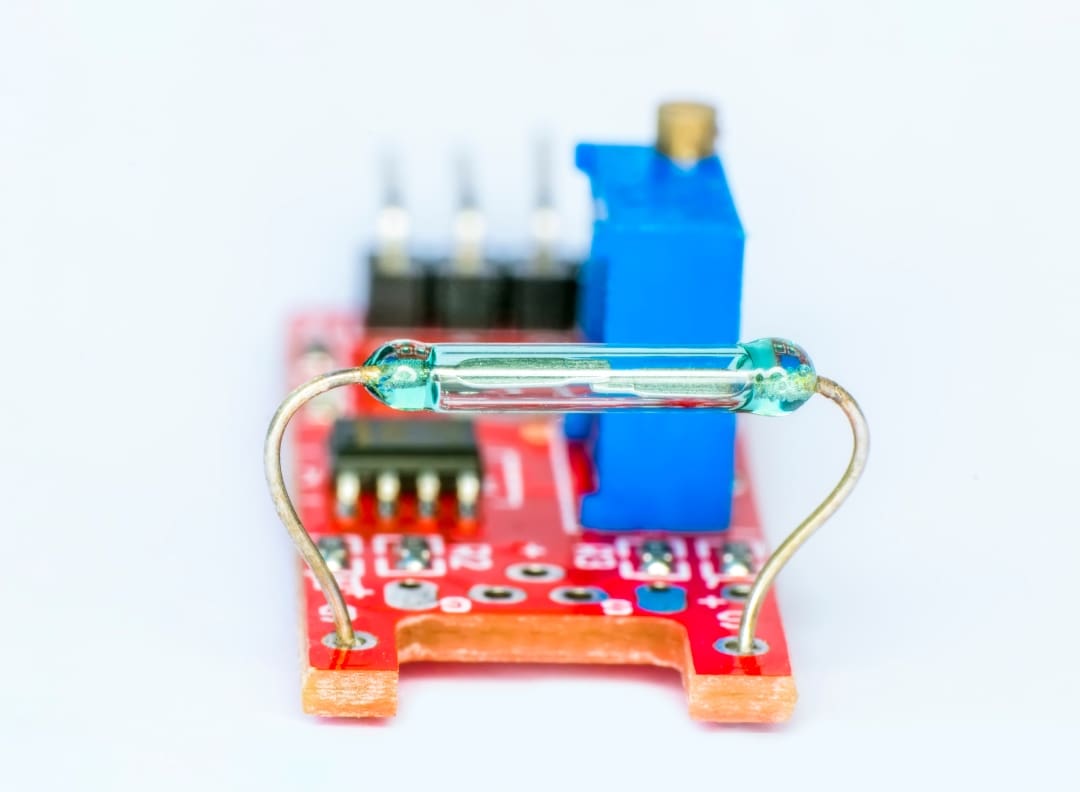
Here’s how to install and how to use a reed switch when adding them to a circuit.
- Select the Right Switch: Choose a switch type (NO, NC, or Changeover) that matches your application. Ensure its electrical ratings (voltage and current) are sufficient for your circuit.
- Mount the Switch: Fix the reed switch in the desired location, such as a door frame or a machine casing. For reed sensors with a pre-mounted enclosure, use screws or adhesives to secure them firmly.
- Position the Magnet: The permanent magnet that activates the switch must be mounted on the moving part of the application (e.g., the door, the lid, or a moving arm). Refer to the manufacturer’s "pull-in" and "drop-out" distances (the range at which the switch will reliably close and open) to ensure the appropriate distance between the magnet and the switch.
- Wire the Circuit: Connect the reed switch into your circuit.
- Normally Open (NO): Connect the two terminals in series with your load and power source. The circuit will be open until the magnet is present.
- Normally Closed (NC): Connect the two terminals in series. The circuit will be closed until the magnet is present.
- Changeover: Wire the common terminal to your power source and the NO and NC terminals to your respective loads.
- Test the System: Before finalising the setup, manually move the magnet past the switch to verify that it reliably activates and deactivates your circuit as expected.
Handling Precautions
- Avoid Excessive Current: The contacts inside a reed switch are sensitive. Exceeding the specified switching current can cause contact welding or a shortened lifespan. Always operate within the datasheet limits.
- Protect with Resistors: If switching an inductive load (like a relay coil), use a protective component like a freewheeling diode. For capacitive loads, use a series resistor to limit inrush current and prevent contact damage.
- Prevent Mechanical Stress: The glass capsule is fragile. Avoid bending the leads close to the glass seal or subjecting the switch to shock or vibration, which can cause the seal to crack and lead to device failure.
Advantages and Disadvantages of Reed Switches
Like any technology, reed switches have specific strengths and weaknesses that determine their suitability for an application. Understanding these is crucial when deciding if a reed switch is the right component for your design.
Advantages
- Long Lifespan and High Reliability: The hermetically sealed contacts are protected from oxidation, dust, and corrosion, leading to an extremely long mechanical life, often in the billions of operations. This is a key benefit of what is a reed switch.
- Low Power Consumption: Reed switches require no power to maintain their open or closed state, making them an excellent choice for battery-powered or low-power applications.
- Contactless Operation: The non-contact nature of the switch eliminates mechanical wear on the contacts and surrounding components, ensuring a long and reliable service life.
- Cost-Effective and Simple: Due to their simple construction, reed switches are an economical solution for a wide range of sensing and switching tasks.
- High-Speed Switching: They can operate at very high speeds, making them suitable for high-frequency counting and position-sensing applications.
Disadvantages
- Susceptibility to Magnetic Fields: A major disadvantage is that they can be inadvertently triggered or jammed by strong, unintended magnetic fields from nearby motors, magnets, or other electrical components.
- Fragile Glass Capsule: The glass envelope, while protective, is susceptible to mechanical shock and stress, which can cause it to break. Careful handling is required during installation.
- Limited Current and Voltage Rating: The small size of the contacts means they can only handle relatively low current and voltage loads. For higher power applications, they are often used to trigger a relay or solid-state switch.
In summary, the advantages and disadvantages of reed switches make them an invaluable tool for specific applications across Malaysia.
They excel where a simple, reliable, and low-power sensing solution is required in sealed or challenging environments. However, their limitations with high current and physical fragility mean they are not a universal solution. Reed switches are best suited for position sensing in security systems, level detection in fluid containers, and non-contact switching in automated machinery, where their strengths can be fully leveraged.