- Published 17 Nov 2025
- Last Modified 17 Nov 2025
- 11 min
Comprehensive Guide to Miniature Circuit Breakers (MCB)
Learn how to select the right Miniature Circuit Breaker (MCB). This guide covers trip curves, rated current, kA ratings, and Malaysian standards.

Miniature Circuit Breakers (MCBs) are fundamental non-sacrificial protection devices engineered to safeguard electrical installations from overcurrents. Installed widely in residential, commercial, and industrial distribution boards, Miniature Circuit Breaker (MCB) provides critical, automatic protection against electrical overloads and short circuits.
Understanding its operational principles, specifications, and selection criteria is paramount for ensuring electrical safety and system reliability. This guide provides a detailed technical overview of MCBs, including their trip characteristics, key specifications, and installation rules pertinent to Malaysian standards.
What is an MCB?
/what-is-an-mcb.jpg)
A Miniature Circuit Breaker (MCB) is a thermomagnetic, electromechanical switch designed to automatically interrupt an electrical circuit to prevent damage caused by excessive current. Unlike fuses, which operate once and require replacement after a fault, MCBs are resettable (either manually or automatically), enabling restoration of power after fault clearance. MCBs are universally installed in modern consumer units, distribution boards, and equipment control panels across residential, commercial, and industrial sectors.
Function of an MCB
The primary function of an MCB is to provide autonomous and reliable overcurrent protection, ensuring personnel safety, prolonging appliance life, and maintaining the integrity of the electrical wiring infrastructure. It achieves this by reliably disconnecting the circuit during two specific abnormal conditions.
- Protection Against Overload: The MCB detects and trips when the current flowing through a circuit exceeds its rated value for a sustained period. This prevents overheating of conductors and insulation, which is a common cause of electrical fires.
- Protection Against Short-Circuit: It provides instantaneous tripping in the event of a short-circuit fault, where the current can surge to thousands of amperes. This rapid interruption minimises the risk of arc flash, equipment damage, and fire.
- Switching Function: An MCB also functions as a manual switch, allowing operators to de-energise a circuit for maintenance or servicing purposes by simply toggling its actuator.
- Advantage Over Fuses: The key advantage of an MCB over a traditional fuse is its resettable nature, which improves operational uptime and reduces maintenance costs associated with replacing fuselinks.
How Does a Miniature Circuit Breaker Work?
The operation of an MCB is based on a dual-trip mechanism housed within its insulated casing, combining thermal and magnetic principles to detect and respond to both overloads and short circuits. Key internal components include the latching mechanism, actuator, arc chute, bimetallic strip, and solenoid coil. When the MCB trips, the internal mechanism separates the electrical contacts, and the arc chute safely extinguishes any electrical arc that forms.
Overload Protection (Thermal Trip)
Overload protection is managed by a bimetallic strip. This component is composed of two dissimilar metals with different coefficients of thermal expansion bonded together. During normal operation, current flows through the strip without issue. When a sustained overload current occurs, the strip heats up.
Due to the different expansion rates of the metals, the strip bends. This calibrated bending action eventually unlatches a mechanical trip mechanism, which opens the electrical contacts and interrupts the circuit. The time taken for the strip to bend and trip is inversely proportional to the current, allowing harmless, temporary inrush currents to pass without tripping.
Short Circuit Protection (Magnetic Trip)
Short circuit protection is handled by an electromagnetic solenoid coil. Under normal conditions, the magnetic field generated by the current flowing through the coil is insufficient to actuate the tripping mechanism.
However, during a short-circuit fault, the current rises instantaneously to a very high magnitude. This generates a strong magnetic field in the solenoid, which rapidly drives a plunger or armature. This plunger strikes the trip lever, unlatching the contacts almost instantaneously (typically within milliseconds) to disconnect the power supply and mitigate the destructive effects of the fault current.
MCB Trip Curve Types
MCBs are manufactured with different instantaneous tripping current characteristics, known as "trip curves," to accommodate the varying inrush current demands of different types of electrical loads. Selecting the appropriate trip curve is critical to prevent nuisance tripping while ensuring adequate protection.

Type B MCBs
A Type B MCB is designed to trip instantaneously when the fault current is between 3 to 5 times its rated current (In). These are primarily used for circuits with purely resistive loads or loads with very low inductive components, where switching surges are minimal.
Typical Applications: Domestic and residential lighting circuits, general-purpose socket outlets, and heating elements.

Type C MCBs
A Type C MCB trips instantaneously when the fault current is between 5 to 10 times its rated current (In). This is the most common type used for general-purpose applications in commercial and industrial environments, as it provides a good balance between protection and tolerance for moderate inrush currents.
Type C is the predominant trip curve specified for both residential and commercial installations in Malaysia due to its versatility.
Typical Applications: Fluorescent lighting, small motors (fans, pumps), control circuits, and commercial socket outlets.

Type D MCBs
Type D MCB is engineered for circuits with high inrush currents, tripping instantaneously when the fault current reaches 10 to 20 times its rated current (In). This high threshold prevents the MCB from tripping during the normal start-up of equipment with significant inductive loads.
Typical Applications: Large electric motors, transformers, welding equipment, and industrial machinery.
Why MCBs Are Important in Malaysia
In Malaysia, the standard electrical supply is 230 V for single-phase and 400 V for three-phase systems. With rising industrialisation and increasing residential electricity consumption, robust circuit protection is non-negotiable. Properly specified MCBs are the first line of defence against electrical faults, preventing equipment damage and significantly reducing the risk of fires in homes, offices, and manufacturing facilities.
Key Specifications in MCBs To Know
Selecting the correct MCB requires a thorough understanding of its key electrical parameters to ensure it is compatible with the circuit it protects.
/key-specifications-in-mcbs-to-know.jpg)
Number of Poles (1P, 2P, 3P, 4P)
The number of poles indicates how many conductors the MCB can simultaneously protect and disconnect.
- 1P (Single Pole): Protects a single-phase conductor. Used for standard single-phase circuits like lighting and socket outlets.
- 2P (Double Pole): Disconnects both the phase and neutral conductors. Used in single-phase applications where complete isolation is required.
- 3P (Triple Pole): Protects and disconnects all three phase conductors in a three-phase system.
- 4P (Four Pole): Disconnects all three phase conductors plus the neutral conductor. Used in three-phase systems with a neutral, providing complete isolation from the supply.


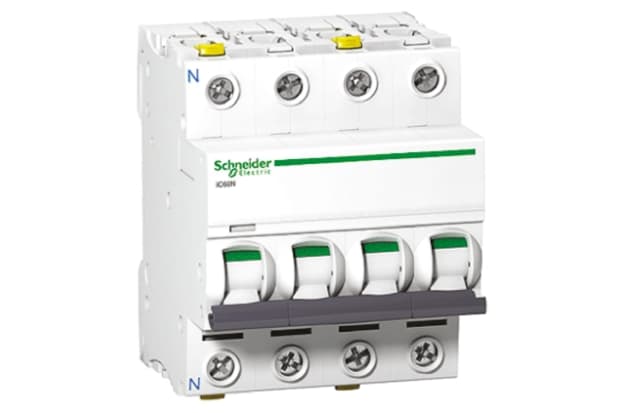
Rated Current (In)
The rated current is the maximum current that the MCB can carry continuously without tripping. It is crucial to select an MCB with a rating that is higher than the normal operating current of the load but lower than the current-carrying capacity of the circuit's wiring. Common MCB ratings in Malaysia for residential use include 6 A for lighting circuits, 16 A or 20 A for socket outlets, and 32 A for high-power appliances like water heaters and HVAC air conditioning systems.
Breaking Capacity (kA Rating)
The breaking capacity (or interrupting rating) is the maximum prospective short-circuit current that the MCB can safely interrupt without being damaged. This rating must be equal to or greater than the prospective short-circuit current (PSCC) at the point of installation. In Malaysia, a breaking capacity of 6 kA is common for residential installations, while 10 kA or higher is often specified for commercial and industrial buildings where the fault currents from the supply transformer are typically higher.


Rated Voltage (V)
The rated voltage of the MCB must be suitable for the system voltage. MCBs for use in Malaysia must be rated for the standard supply voltages: 230 V for single-phase and 400 V for three-phase systems. Using an MCB with an incorrect voltage rating can compromise its ability to safely interrupt a fault.
Beyond the MCB's own specifications, the protective enclosure it's housed in is also critical. This housing's level of protection against solids (like dust) and liquids is defined by its IP rating. For example, an enclosure for an outdoor or industrial installation requires a high rating, such as IP65, to protect the internal components and ensure the entire system's safety and longevity.
MCB Wiring Rules
Adherence to national standards is mandatory for safe and compliant electrical installations in Malaysia. Key wiring rules are governed by the Suruhanjaya Tenaga (Energy Commission) and Malaysian Standards.
Connection to Live Conductor Only
According to standard wiring practices, the MCB must be installed in series with the live (phase) conductor of the final circuit. It should never be placed in the neutral conductor alone, as this would leave the circuit energised and unsafe even when the MCB has tripped.
Ensure Correct Rating and Trip Curve Selection
The selection of the MCB's current rating and trip curve must be coordinated with the load requirements and the size of the circuit cable to ensure proper protection. This is mandated by standards such as MS IEC 60898-1:2007, which specifies the performance requirements for AC MCBs. An oversized MCB will fail to protect the cable from overheating, while an undersized one will lead to nuisance tripping.
Coordination with RCD/RCBO for Safety
For circuits supplying socket outlets and installations in wet areas (e.g., bathrooms), Regulation 36 of the Electricity Regulations 1994 and the MS 1979:2007 Code of Practice mandate additional protection against earth leakage faults. This is achieved by installing a Residual Current Device (RCD) or a Residual Current Circuit Breaker with Overcurrent protection (RCBO).
An RCD with a sensitivity of 30 mA is typically required for personnel protection, while a 10 mA device may be used for highly sensitive applications. The MCB provides overload and short-circuit protection, while the RCD/RCBO provides protection against electric shock.
Why Does My MCB Keep Tripping?
Frequent tripping of an MCB is an indication of an underlying issue in the electrical circuit. It is a safety feature at work and should not be ignored. Common causes include:
- Overloaded Circuit: This is the most common reason. It occurs when too many high-power appliances are connected to a single circuit, drawing more current than the MCB's rated value. The solution is to redistribute the load across different circuits.
- Faulty Appliance: A short circuit or a ground fault within an appliance can cause an instantaneous surge in current, tripping the MCB. To identify the faulty device, unplug all appliances on the circuit and plug them back in one by one until the MCB trips again.
- Loose Connection: A loose wire at the terminal of the MCB, a socket outlet, or a switch can cause arcing and intermittent high current draw, leading to tripping. This requires inspection and tightening of all connections by a qualified electrician.
Frequently Asked Questions about Miniature Circuit Breakers (MCBs)
Related links
- MCBs
- ABB Miniature Circuit Breaker Series Contact Block 1 NO
- Schneider Electric Easy9 Easy9 Miniature Circuit Breaker 20A 230V ac AC, 6 kA Breaking Capacity
- A Complete Guide to RCBOs
- Lockouts
- Isolators & Switch Disconnectors Guide
- Siemens SENTRON Handle Locking Device for use with 5SP 5TE8 Miniature Circuit Breakers, Padlock with Maximum 3 mm
- Schneider Electric Spacer for use with C120/C60 Miniature Circuit Breakers Duo