Potentiometers
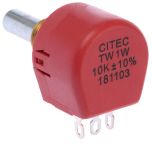
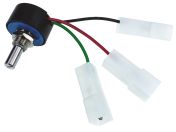
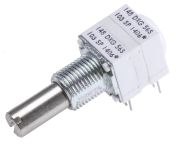
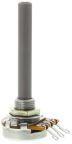
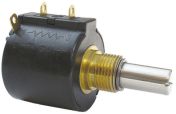
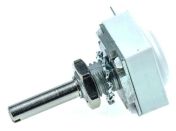
A potentiometer, sometimes called a “pot”, rotary pot, or potmeter, is a three-terminal variable resistor used primarily as a voltage divider, enabling smooth adjustment of signal levels, reference voltages, or set points in an electrical circuit.
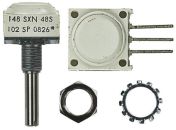
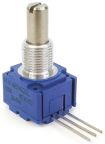
A typical potentiometer you can buy online has three terminals. Two terminals connect to the ends of a resistive element, which may be made from wirewound material, carbon, cermet, or conductive plastic. The third terminal connects to the wiper, which slides or rotates along the resistive track to tap off a variable portion of the total resistance.
As the wiper moves, the resistance between the wiper and each end of the track changes, providing precise control of output voltage or circuit current within the component’s rated power limits. This simple structure makes potentiometers popular for front-panel controls (e.g., volume, speed, brightness) and for position sensing where mechanical motion is converted into an electrical signal.
Types of Potentiometers
Rotary Potentiometers
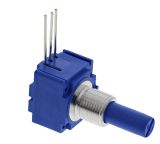
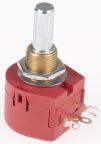
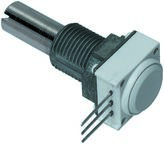
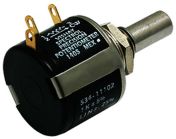
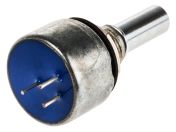
Rotary potentiometers are controlled by turning a spindle or knob. They are available as single-turn or multiturn options, providing variable resistance for a wide range of applications. A common variant is the radial potentiometer, where the shaft extends perpendicular to the resistive track, making it suitable for standard panel mounting and circular control layouts.
Slide Potentiometers
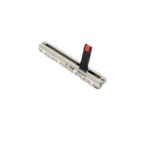
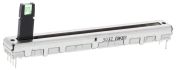
Slide potentiometers, also called faders, use a linear slider that moves along a straight resistive track. Their linear motion makes it easy for users to see and adjust levels at a glance, which is why they are common in audio mixing consoles, lighting desks, and user interface panels. Slide pots are particularly suited to applications where position directly represents a parameter value, such as level, balance, or speed control.
Trimmer Potentiometers
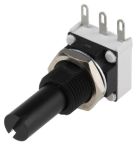
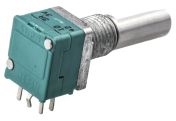
Trimmer potentiometers, or trimpots, are used to fine-tune and calibrate circuits. They can be mounted directly on a PCB and adjusted easily with a screwdriver. Trimpots are commonly used to set reference voltages, offset levels, and sensor calibration points, where the adjustment is made once during commissioning or maintenance and then left untouched.
String Potentiometers
String potentiometers, or string pots, convert linear or rotary movement into an electrical signal, making them useful for position sensing and motion tracking applications. These devices are popular in industrial and automation applications for measuring position, stroke length, or movement in machinery and structural monitoring, especially where long travel ranges need to be sensed in a compact form factor.
Membrane Potentiometers
Membrane potentiometers are completely flat and change resistance when pressure is applied, offering compact and durable solutions for touch-sensitive or pressure-based controls. Their sealed construction offers resistance to dust and moisture, making them suitable for harsh or hygienic environments where conventional mechanical sliders might wear or clog more easily.
Do I Need a Potentiometer with a Linear or Logarithmic Taper?
The taper of a potentiometer determines how its resistance changes as the wiper moves, and the right choice depends on your application.
Linear Taper
The resistance changes at a constant rate along the track. For example, turning the knob or sliding the fader to the midpoint gives half the total resistance. Linear taper potentiometers are ideal for applications requiring uniform adjustment, such as light dimmers or precise voltage control.
Logarithmic Taper
In a logarithmic taper, the resistance changes exponentially rather than evenly. Logarithmic taper potentiometers are commonly used in audio applications, where perceived changes in volume or signal need to match human hearing.
What Is the Difference Between a Potentiometer and a Rheostat?
Although they share similar construction, potentiometers and rheostats differ in how they are wired and used in circuits. A potentiometer has three terminals and is designed to work as a voltage divider, providing a variable output voltage between one end of the track and the wiper. A rheostat uses only two terminals and functions purely as a variable resistor, adjusting the current flowing through a circuit.
In practical terms, potentiometers are often used for signal-level adjustments, while rheostats (often higher power wirewound parts) are chosen for current control and load regulation.
Differences Between Rotary, Linear, and Digital Potentiometers
Potentiometers come in mechanical and electronic forms, each suited to specific applications and environments:
- Rotary Potentiometers: Provide angular adjustment, are simple to use, and are ideal for compact front-panel controls where space is limited and rotary knobs are preferred.
- Linear (Slider) Potentiometers: Resistance is changed by sliding a contact along a straight track. Ideal for faders, user interfaces, or applications where proportional adjustment is needed.
- Digital Potentiometers: Emulate the behaviour of an analogue pot but are controlled via digital interfaces such as SPI or I²C and implemented as resistor ladders with programmable wiper positions.
Digital potentiometers offer advantages such as precise, repeatable adjustment, making them ideal for microcontroller-based applications, and often non-volatile memory that stores the wiper position across power cycles. They are widely used for automatic calibration, gain setting, and replacing mechanical pots in systems where long-term stability, miniaturisation, or software control is required.
Potentiometer Compatibility with Different Circuits
Consider the following factors when integrating potentiometers into your design:
- Resistance Value: Match the potentiometer’s resistance to your circuit’s requirements to avoid signal distortion or excessive loading.
- Taper Type: Choose linear or logarithmic taper based on how the circuit should respond, such as precise voltage division or audio control.
- Tolerance and Power Rating: Ensure the potentiometer can handle the circuit’s power levels while maintaining accuracy.
- Wiring Configuration: Use the appropriate setup, voltage divider for variable voltage, rheostat for variable resistance.
- Digital Interfaces: For digital potentiometers, confirm compatibility with SPI or I²C and ensure voltage and impedance match the circuit.
- Physical Dimensions and Mounting: Verify the size and mounting style to fit your PCB, enclosure, or panel layout.
- Multi-Channel Options: Use multi-gang or dual-gang potentiometers for controlling multiple parameters with a single unit.
- Environmental Ratings: For harsh or outdoor environments, look for sealed or IP-rated potentiometers and accessories such as sealing boots, which protect against dust, moisture, and contaminants.
Potentiometer Life Expectancy and Durability Factors
A potentiometer’s lifespan depends on its construction, materials, and operating environment. Mechanical wear, contamination, and repeated use all play a role in how long a device performs reliably:
- Typical Lifespan: Standard rotational potentiometers generally last tens of thousands of cycles, while digital potentiometers can operate far longer.
- Material Durability: Carbon track potentiometers wear out faster, whereas wirewound, cermet, and conductive plastic tracks offer greater durability and smoother long-term performance.
- Environmental Exposure: Humidity, temperature extremes, dust, and vibration can accelerate wear and reduce accuracy over time.
- Build quality and Sealing: High-quality materials and sealed housings help protect internal components from contaminants, making them more suitable for harsh or industrial environments.
- Mechanical Wear: Repeated operation gradually affects the wiper and resistive track, leading to drift, noise, or inconsistent resistance readings.
- Maintenance and Care: Regular inspection helps detect degradation early. In some mechanical designs, appropriate lubrication can reduce friction and extend lifespan.
Industrial Applications of Potentiometers
Potentiometers are essential for adjusting settings, calibrating devices, and monitoring positions across mechanical and electronic systems. Key industrial applications include:
- Automotive: Used in throttle position sensors, dashboard instrumentation, and volume controls.
- Medical: Integrated into medical devices and diagnostic equipment to control dosage, calibration, and positioning.
- Aerospace: Applied in flight control systems, navigation instruments, and cockpit interfaces.
- Manufacturing: Regulate machinery, automation systems, and robotics.
- Oil & Gas: Monitor valves, actuators, and flow control systems in harsh environments.
- Packaging: Adjust packaging machinery, conveyor speeds, and automated filling systems.
- Electronics: Essential for volume, tone, and signal adjustments in audio equipment, consumer electronics, and instrumentation.
- Laboratory: Used in test rigs, experimental setups, and analytical equipment.
Complete Your Potentiometer Assembly with Peripherals
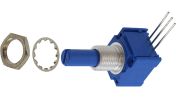
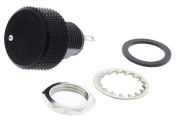
Make your potentiometer easier to use and install with the right supporting parts. Find potentiometer knobs for precise control and browse additional potentiometer accessories like mounting nuts that help you fine-tune or protect your setup.
Your Trusted Potentiometer Supplier in Malaysia
Find the right potentiometers for any industrial, automotive, medical, or electronics application at RS Malaysia. As a trusted supplier and distributor, we stock a wide range of high-quality potentiometers from leading brands like Vishay, Bourns, and TE Connectivity at competitive prices. Explore our online range to source potentiometers, multimeters, and oscilloscopes designed for commercial and industrial applications.
Ordering is simple. Select the products you need, add them to your cart, and complete your purchase via our secure online checkout. For detailed information on shipping times, costs, and coverage across Malaysia, visit our Delivery Information page.