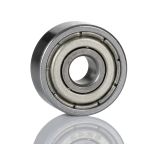
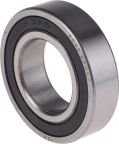
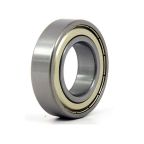
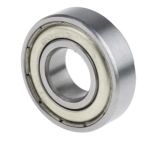
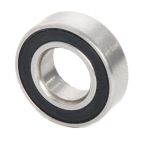
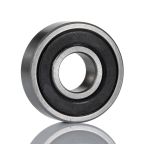
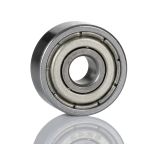
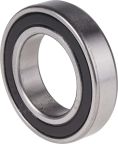
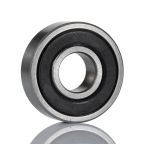
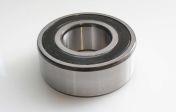
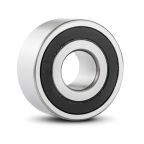
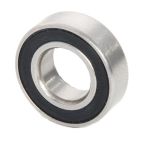
Ball Bearings
Ball bearings, also known as journal bearings, are important mechanical components used in a wide range of applications. They are an integral part of various machines and mechanisms, from small household appliances to large industrial equipment.
What Are Ball Bearings?
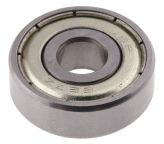
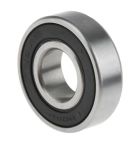
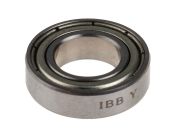
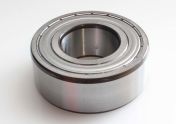
A ball bearing is a type of rolling-element bearing that utilises spherical balls to maintain separation between the moving parts, or races, of the bearing. This design effectively reduces the surface area contact between the races, minimising rotational friction and allowing high-speed operation with less power consumption. For more in-depth information please refer to our ball bearings guide.
Ball Bearing Types
There are four main types of ball bearings used in the industry today. They are
Deep Groove Ball Bearings
Deep Groove Ball Bearings are one of the most used ball bearing types. They have a simple design and are easy to maintain. Deep groove ball bearings can manage both radial and axial loads in both directions, making them ideal for higher load applications. Deep groove ball bearings are available in single or double row variants.
Angular Contact Ball Bearings
Angular Contact Ball Bearings have a contact angle that enables forces to be transferred from one raceway to another at a specific angle. Ideal for handling combined radial and axial loads, these bearings have an angled raceway that allows them to support thrust in addition to radial forces. Angular contact bearings come as single or double row, with double row variants having fixed inner and outer ring units.
Self Aligning Ball Bearings
Self Aligning Ball Bearings work in a similar way to standard ball bearings but feature two rows of balls which help with alignment by rotating in parallel with the outer ring. The inner ring features two raceways and the outer ring has one raceway.
Thrust Ball Bearings
Thrust Ball Bearings are specifically designed to handle axial loads. They have two bearing discs with raceways for the balls and are designed to support axial loads in one direction only. Thrust ball bearings are often used in applications where high axial load capacity is required.
Factors to Consider When Selecting a Ball Bearing
Procuring the correct ball bearing requires careful technical evaluation to ensure the component meets the precise operating requirements of your machinery. Consider the following factors before you buy ball bearing units:
- Load Type and Direction: Determine the type and direction of load (radial, axial, or combined). This directly influences the basic bearing design (e.g., deep groove vs. angular contact) and its capacity.
- Size Constraints: Match bearing size to available installation space. Ensure the selected inner diameter (ID) and outer diameter (OD) comply with the shaft and housing constraints, especially when purchasing a large bearing.
- Operating Speed: Evaluate the required operating speed range. High-speed applications demand specific cage materials, lubrication, and higher precision classes to manage heat generation.
- Temperature Resistance: Check operating temperature and heat resistance. Choose bearings and seals (e.g., sealed ball bearings) capable of continuous operation within the ambient and generated temperature limits.
- Accuracy and Precision: Assess desired accuracy and rotational precision. Select the appropriate tolerance class (e.g., P5, P6) based on the application's requirement for smooth and accurate running.
- Rigidity and Vibration: Consider rigidity and vibration tolerance. Applications requiring high stiffness (low deflection) may necessitate specialised or preloaded bearing configurations.
- Alignment Capability: Examine alignment capability for shaft or housing deflection. If misalignment is anticipated, selecting a self-aligning type is necessary to prevent premature failure.
- Lubrication and Maintenance: Select appropriate lubrication method and maintenance needs. Decide between oil bath, grease packing, or pre-lubricated sealed ball bearings.
Storage and Care Recommendations for Longer Lifespan
Proper storage and handling are critical to preserving the precision and contamination-free state of steel ball bearing units before installation. Mismanaged storage significantly shortens operational lifespan.
- Store bearings in their original, sealed packaging: This protects against humidity, dust, and environmental contamination until the moment of installation.
- Keep storage areas clean, dry, and vibration-free: Vibration, especially on concrete floors, can cause false brinelling (minor indentations) in the races.
- Maintain room temperature below 40°C with low humidity: High humidity is the primary cause of corrosion and rust, even on precision steel surfaces.
- Place bearings horizontally on shelves, not directly on the ground: Avoid direct contact with cold, potentially damp concrete floors.
- Avoid stacking boxes too high to prevent pressure damage: Excessive weight can damage the seals or cause indentation of the races, particularly in large bearing packages.
- Handle with clean gloves to prevent corrosion from skin oils: Fingerprints contain salts and acids that can initiate corrosion on exposed steel ball bearing surfaces.
- Protect bearings from dust, moisture, and direct sunlight: Environmental factors accelerate degradation.
- Rotate stock regularly using first-in, first-out (FIFO) method: This ensures that older, potentially unsealed stock is used before moisture or lubricant degradation occurs.
- Apply protective oil or grease for long-term storage: If the original seal is broken, immediate re-lubrication and re-sealing are necessary.
Industrial Application of Ball Bearings
As a versatile ball bearing supplier, RS Malaysia supports critical applications across numerous industrial sectors, where smooth rotation is non-negotiable:
- Automotive manufacturing and electric vehicles: Used extensively in motors, transmissions, and wheel hubs, demanding high performance and sealed ball bearings.
- Aerospace and defence engineering: Requiring specialised, high-precision bearings for flight controls, actuators, and turbine systems.
- Industrial machinery and automation equipment: Essential for machine tools, conveyor systems, pumps, and compressors.
- Robotics and precision instruments: Utilising small, low-friction bearings for precise movement and positional accuracy.
- Mining and construction machinery: Using robust, large bearing units designed to withstand heavy, shock loads and contaminants.
- Railways and transportation systems: Employed in gearboxes, axles, and traction motors where reliability under extreme load is mandatory.
- Agricultural and farming equipment: Designed to handle dirt and contamination in heavy-duty off-road applications.
- Marine and offshore applications: Utilising specialised corrosion-resistant materials and seals.
- Renewable energy and wind turbines: Requiring massive, highly durable main shaft and gearbox bearings to handle extreme forces.
- Chemical and food processing industries: Using stainless steel ball bearing units and specialised seals to resist corrosion from chemicals or washdown procedures.
- Medical devices and healthcare equipment: Precision miniature bearings are used in surgical robots and diagnostic imaging equipment.
RS Malaysia Is Your Trusted Partner for Ball Bearings
RS Malaysia is your trusted ball bearing supplier and distributor, stocking a vast range of steel ball bearing units, including sealed ball bearings and large bearing types. We carry thousands of products from global brands like RS PRO, SKF, FAG and other leaders in mechanical components, ensuring you find the right part at a competitive ball bearing price.
In addition to ball bearings, our user-friendly website makes it easy to search, compare, and order related mechanical essentials you need, such as ratchet ring spanners, centrifugal fans, and rotary pots. Buy every component you need online with fast, reliable delivery. For full details on our delivery services and associated fees, please refer to our dedicated Delivery page.