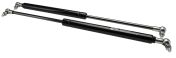
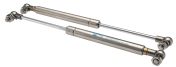
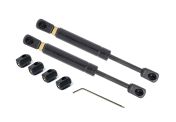
Gas Struts
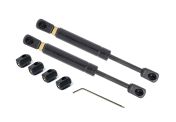
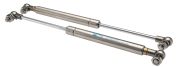
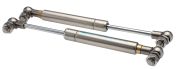
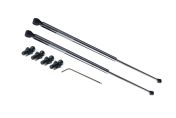
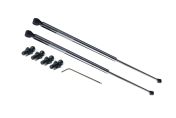
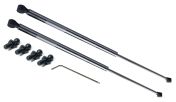
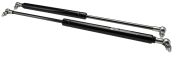
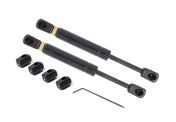
Also known as gas springs, gas struts are ingenious mechanical components designed to provide controlled motion, support, and dampening. Often found in everyday applications, these versatile devices make lifting, lowering, and positioning heavy objects effortless, enhancing both convenience and safety across a vast array of industries.
How Does a Gas Strut Work?
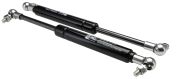
A gas strut construction is very simple. It comprises a precision rod attached to a piston and a central tubular body containing compressed nitrogen gas and lubricating oil. When force is applied to the protruding portion of the rod, it presses onto the piston head a bit like a plunger on a syringe, compressing the nitrogen gas. This creates an internal pressure that exceeds the pressure outside of the cylinder closing the gas strut. When the force is removed from the external rod the gas is decompressed and the pressure pushes the piston back out again, opening the gas strut. This controlled compression and decompression provide smooth, dampened motion and reliable support.
Types of Gas Strut
Gas struts come in various types to suit different applications:
- Stop and Stay: These gas struts hold a position firmly, ideal for applications where the strut must maintain a fixed angle or position without additional support.
- Variable Pressure: These provide adjustable force and motion control, suitable for applications requiring variable resistance or smooth dampening.
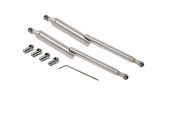
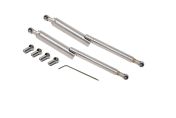
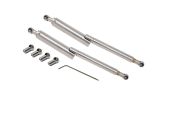
Gas struts are available with steel or stainless-steel bodies. When selecting a gas strut, consider factors such as stroke length, extended length, force range, and compatible end fittings to ensure proper fit and function.
Gas Strut Sizes
Gas struts vary in rod and tube diameters, which correlate with their force capacities:
- 6mm Rod Diameter and 15mm Tube Diameter: These lighter-duty struts typically offer a force range from 50 to 400 N (11-90 lbs), suitable for smaller covers or panels.
- 8mm Rod Diameter and 18mm Tube Diameter: Stepping up in power, these struts provide a force range from 100 to 650 N (22-146 lbs), ideal for medium-sized applications.
- 10mm Rod Diameter and 23mm Tube Diameter: This size offers substantial force, ranging from 150 to 1200 N (34-269 lbs), often found in car boots or machine guards.
- 14mm Rod Diameter and 28mm Tube Diameter: These heavy-duty struts deliver significant force, from 200 to 2500 N (45-562 lbs), for very large or heavy lifting tasks.
Benefits of Using Gas Struts
Gas struts offer significant advantages over traditional mechanical springs or manual lifting mechanisms, providing enhanced functionality and user experience.
- Smooth Motion: Gas struts provide a controlled and dampened movement, eliminating abrupt slamming or rapid lifting. This smooth action enhances user comfort and reduces wear and tear on the attached components.
- Easy Lifting: By counterbalancing the weight of a lid, door, or panel, gas struts significantly reduce the effort required for lifting and opening. This makes access easier and safer, particularly for heavy or awkward objects.
- Space-Saving Design: The compact and self-contained nature of gas struts allow for efficient use of space. Unlike bulky mechanical springs, they require minimal clearance and can be discreetly integrated into various designs.
- Low Maintenance: Gas struts are generally sealed units that require very little maintenance once installed. Their internal components are protected from dust and debris, contributing to their long and reliable operational life.
Choosing the Right Gas Strut
Selecting the appropriate gas strut is essential for optimal performance, safety, and longevity in your specific application. Careful consideration of several key features will ensure you choose a strut that perfectly matches your needs.
- Based on Force Needed: This is the most critical factor. The force rating of a gas strut, measured in Newtons (N) or pounds (lbs), must match the weight it needs to support, or the force required for controlled movement. An undersized strut won't provide enough assistance, while an oversized one can make movement too stiff.
- Stroke Length: The stroke length defines how far the rod can extend or retract. This must correspond precisely to the required opening or closing distance of the application, ensuring full range of motion without overextension or insufficient reach.
- Size and Fit: The overall dimensions of the gas strut, including rod and tube diameter, must fit within the available space of your application. Compatibility with mounting points and clearance for movement are crucial.
- Material: Gas struts are commonly available in steel or stainless steel. Steel is suitable for general applications, while stainless steel offers superior corrosion resistance, making it ideal for marine, outdoor, or humid environments.
- Type of Application: Consider whether the strut is used for lifting, lowering, counterbalancing, or holding a position. The application will influence the required force, dampening characteristics, and end fittings of the gas strut.
Industrial Application of Gas Struts
Gas struts are highly versatile components, extensively utilised across a broad spectrum of industrial applications where controlled and assisted motion is required for doors, lids, hatches, and panels.
- Automotive: Beyond car boots, gas struts are essential in automotive manufacturing for bonnets, tailgates, glove compartments, and even seats, providing controlled opening and closing.
- Aerospace: In aircraft, they facilitate the smooth operation of overhead locker doors, emergency exits, and various access panels, ensuring reliability in critical applications.
- Furniture Manufacturing: Gas struts are integral to modern furniture design, enabling soft-close mechanisms for cabinet doors, adjustable bed frames, and ergonomic office chairs for improved user comfort.
- Marine: On boats and other marine vessels, gas struts are crucial for lifting and holding open heavy access hatches, engine covers, and storage compartments, with stainless steel variants offering corrosion resistance in harsh environments.
- Machinery and Equipment: They are used on machine guards, access doors, and protective covers in industrial machinery, providing controlled movement and ensuring safety for operators accessing internal components.
- Medical Equipment: Gas struts are employed in various medical devices, including adjustable hospital beds, examination tables, and medical carts, to provide smooth and precise positioning for patient care and ergonomic use.
- Agricultural Machinery: In agricultural equipment, they assist with the opening and closing of heavy engine hoods, access panels, and storage compartments on tractors and other farm machinery.
Trusted Gas Struts Manufacturer, Supplier & Distributor in Malaysia
When it comes to sourcing high-quality gas struts that deliver reliable performance and smooth operation, RS is your trusted manufacturer, supplier, and distributor in Malaysia. We offer an extensive selection of gas struts designed to meet a wide array of industrial and commercial requirements. Our product range features durable and precise gas springs from leading brands, including Camlock Gas Springs and our own reliable RS PRO brand, ensuring you find the perfect fit for your application.
Beyond gas struts, we also offer a wide array of other essential industrial components, including manometers and hand pumps, providing holistic solutions for your projects.
Enjoy a seamless purchasing experience with competitive pricing and efficient delivery services. For more information on delivery options and policies, please refer to our dedicated Delivery Page.